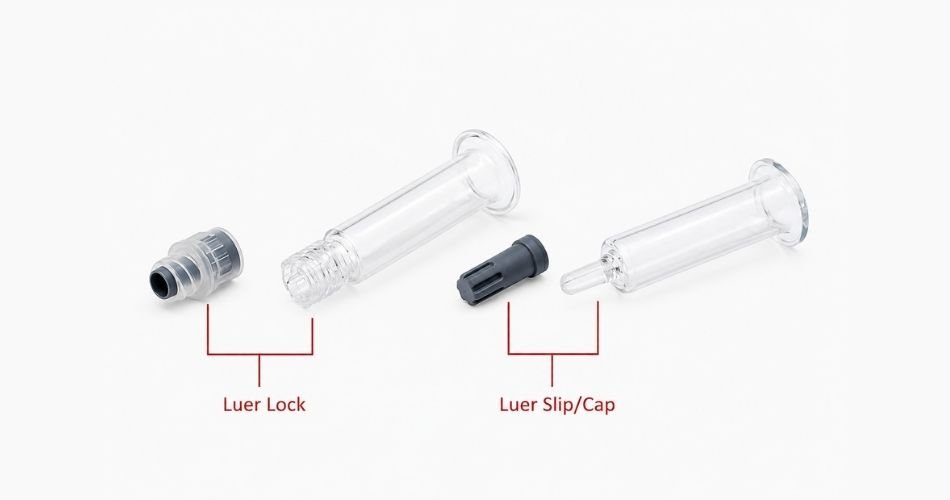
For cannabis extract processors, brands, co-packers, and packaging distributors, choosing between a Luer Lock and Luer Slip distillate syringe is mainly a connection and filling-process decision.
A Luer Lock uses a threaded locking connection, while a Luer Slip uses a tapered push-fit connection. For commercial distillate filling, Luer Lock is commonly the better starting point when a dispensing tip, transfer adapter, or other accessory needs additional mechanical retention. Luer Slip can be suitable when a simpler push-fit connection and faster assembly are more important.
ISO 80369-7:2021 provides a technical reference for Luer Lock and Luer Slip connector design, but the complete syringe configuration should still be validated for the intended cannabis extract filling process.
Neither configuration is automatically better for every project. The choice should be based on the extract at its actual filling temperature, the filling method, connected accessories, closure requirements, and compatibility with the production equipment.
Luer Lock vs Luer Slip: What Is the Difference?
The main difference is how the syringe connects to a compatible cap, dispensing tip, connector, or adapter.
A Luer Lock syringe uses a threaded collar. The compatible component is twisted into position, creating mechanical engagement between the syringe and the attached component.
A Luer Slip syringe, sometimes called a slip-tip syringe, uses a tapered push-fit connection. The compatible component presses onto the tip and holds by friction rather than threads.
For cannabis extract packaging, Buyers need to determine how each connection behaves during their actual filling, assembly, dispensing, packaging, and distribution process.
Quick Comparison for Commercial Distillate Filling
| Factor | Luer Lock | Luer Slip |
|---|---|---|
| Connection method | Threaded locking connection | Tapered push-fit connection |
| Accessory retention | Additional mechanical retention | Relies mainly on friction |
| Assembly | Requires insertion and twisting | Push-on / pull-off |
| Dispensing tips | Useful when secure attachment is important | Suitable when locking is unnecessary |
| Higher dispensing resistance | Often a practical starting point | Requires careful validation |
| Fast assembly | Slightly more handling | Simple and fast |
| Filling equipment | Must match connector or fixture | Must match connector or fixture |
| Closure qualification | Check thread engagement and fit | Check push-fit retention |
| Main validation issue | Accessory fit and locking consistency | Retention during handling and dispensing |
This table is a starting point rather than a substitute for sample testing. Our borosilicate glass syringes are available in both Luer Lock and Luer Slip configurations.
When Should You Choose a Luer Lock Distillate Syringe?
A Luer Lock is usually worth evaluating first when the production process depends on a securely attached accessory.
Common examples include commercial filling processes that use:
- blunt dispensing tips
- transfer connectors
- filling adapters
- relatively high dispensing resistance
Distillate can require substantial dispensing force when it is cool or when it passes through a narrow dispensing tip. That force is transmitted through the syringe, plunger, connector, and accessory.
A threaded Luer Lock provides additional mechanical retention between compatible components. This can reduce the likelihood of an accessory being unintentionally pulled or pushed off during handling.
When Is a Luer Slip Syringe Appropriate?
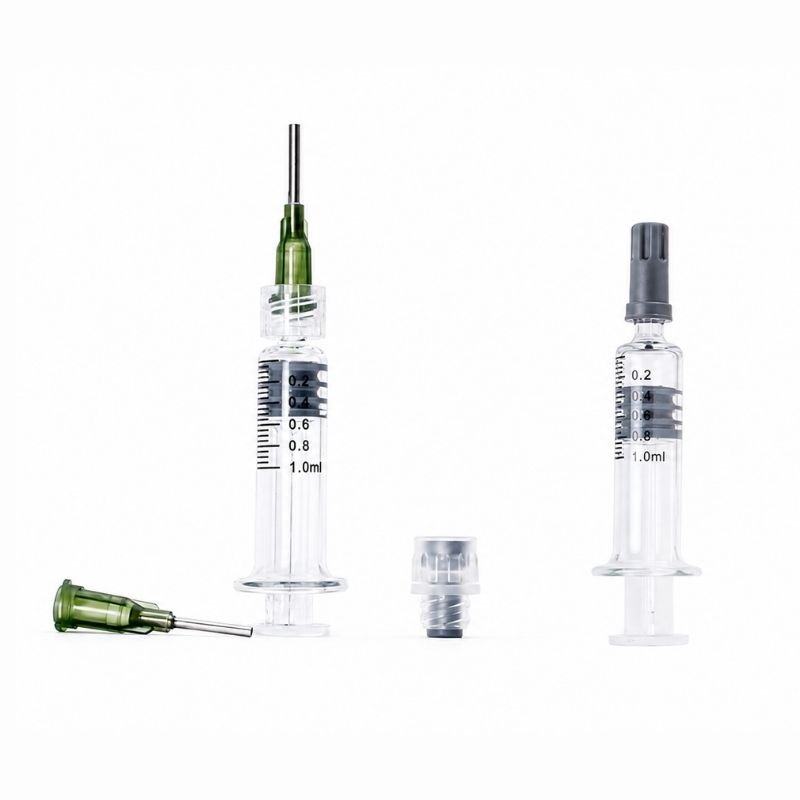
Luer Slip remains a practical configuration for processes that do not require a threaded locking connection.
It may be appropriate when:
- a simple push-fit accessory is used
- connection forces are relatively low
- rapid assembly is operationally useful
- Low-viscosity extracts
For some filling lines, reducing the number of assembly motions can simplify handling. A push-fit connection may also be convenient for manual or semi-automatic operations where operators repeatedly attach and remove compatible components.
How Luer Type Affects Commercial Distillate Filling
Commercial distillate syringe filling depends on several process variables.
Getting distillate into a syringe consistently may require control of:
- filling temperature
- extract viscosity
- dispensing rate
- syringe orientation
- filling fixture
- accessory connection
- plunger assembly sequence
Distillate is commonly warmed during commercial filling because reducing viscosity can improve flow.
Buyers should evaluate the extract at the temperature at which it will actually enter the syringe.
If the filling process transfers extract through a connected adapter or dispensing tip, the Luer connection becomes part of the filling system. With greater resistance, more force may be transmitted through that connection. A Luer Lock is often the more conservative starting point when accessory retention is important.
If the process fills through the open barrel before the plunger is assembled, however, the Luer connection may have less influence on the filling step itself. In that case, closure design and downstream dispensing requirements may become more important.
Projects that experience trapped air, plunger rebound, or difficult plunger insertion should evaluate those issues separately. Air-release glass syringes are designed around the plunger and air-release process rather than the Luer connection itself.
What Buyers Should Confirm Before Quoting
Buyers who have not yet finalized syringe capacity, plunger design, or the overall configuration can first review our empty distillate syringes buyer’s guide.
For a commercial distillate syringe project, send the key production requirements before requesting a final quotation.
- extract or formulation type
- approximate viscosity or flow behavior
- filling temperature
- target fill volume
- filling method
- filling equipment or fixture
- Luer Lock or Luer Slip preference, if already known
- dispensing tip or adapter requirements
- plunger configuration
- graduation requirements
- closure requirements
- assembled or component supply
- customization requirements
- estimated production quantity
Collecting this information reduces the risk of quoting technically different configurations as interchangeable. It also allows the supplier to provide more relevant samples.
For distributors serving multiple cannabis brands, documenting these specifications by project can make repeat quotations and future production orders more consistent.
Noterd PFS can use these project parameters to recommend appropriate glass syringe configurations, prepare sample options for production testing, and provide a wholesale quotation after the specification is confirmed.